
Visual, Recite, or Listen: Which Quran Memorization Method Works for You?
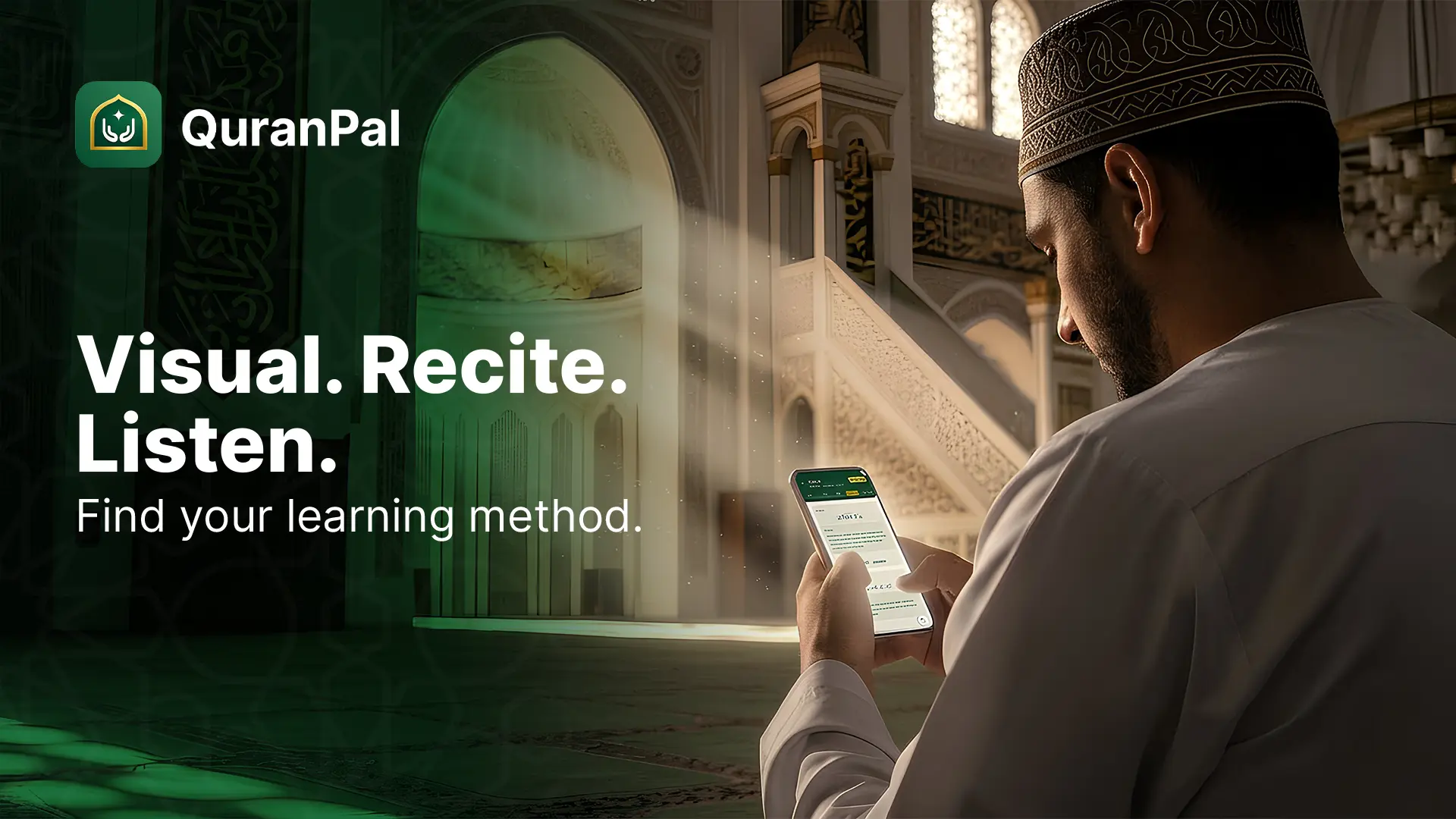
Visual. Recite. Listen. Which one of these learning methods works for your brain to memorize the Quran?
You've tried memorizing a surah before. You repeated it dozens of times. It felt solid for a day or two. Then it slipped away — and you wondered what went wrong.
Here's what nobody told you: the problem wasn't how many times you repeated it. It was how you were learning in the first place.
Cognitive science has shown us for decades that people process and retain information in fundamentally different ways. Some people remember what they see. Others remember what they hear. Others need to physically produce the words to make them stick. This isn't a personality quiz — it's how your brain is wired.
And yet, almost every approach to Quran memorization treats everyone the same: read the Arabic, repeat it, hope it holds.
What if the method shaped itself around you instead?
The Three Methods
There are three core learning methods that align with how your brain naturally absorbs information. Understanding which one fits you best is the single most important step you can take before memorizing a single ayah.
Visual Learning — You Remember What You See
If you've ever remembered where a paragraph was on a page, or recalled a diagram long after the lecture ended, you're likely a visual learner.
For Quran memorization, this means your brain responds best to:
- Colour-coded Arabic text that highlights word roots, grammar patterns, and verse structure
- Written breakdowns where each word is paired with its meaning side by side
- Visual patterns that show how verses connect and repeat across surahs
Visual learners don't just read the Quran — they map it. When you see the structure of a verse laid out clearly, your brain photographs it. The arrangement becomes the memory. You can close your eyes and see the page.
This method is especially powerful for beginners who don't yet read Arabic fluently. When the text is visually organized with meaning attached, you're learning two things at once — the words and what they mean — without feeling overwhelmed.
Recitation-Based Learning — You Remember What You Speak
If you've ever found that reading something aloud helped you remember it, or that you learn best by doing rather than watching, recitation is your method.
For Quran memorization, this looks like:
- Guided pronunciation where you follow along with a reciter, phrase by phrase
- Repeat-after-me exercises that build muscle memory in your mouth and throat
- Recording yourself and comparing your recitation to a trusted reciter like Sheikh Alafasy or Sheikh Sudais
Recitation-based learners anchor words through their own voice. When you hear yourself say Alhamdulillahi Rabbil Aalameen, something different happens in your brain compared to just reading it silently. The motor activity of speaking — the movement of your tongue, the rhythm of your breath — creates a physical memory trace alongside the mental one.
This is why the Quran was originally transmitted through oral recitation, not written text. The act of reciting is itself a form of deep encoding. For learners wired this way, it's the most natural path to memorization there is.
Auditory Learning — You Remember What You Hear
If you've ever memorized a song without trying, or found that a lecture stayed with you longer than a textbook, you're an auditory learner.
For Quran memorization, this means:
- Listening to recitations repeatedly before attempting to memorize
- Absorbing the rhythm, melody, and tajweed of a surah through passive and active listening
- Building familiarity with the sound of each verse before engaging with the Arabic text
Auditory learners need to hear the Quran before they learn it. The melody of a surah — its pauses, its rises, its rhythm — becomes the scaffold that holds the words in place. Once the sound pattern is familiar, the individual words slot in naturally.
This method works especially well for those who feel overwhelmed by Arabic script. Instead of starting with the visual complexity of the text, you start with what the Quran has always been at its heart — something recited, heard, and felt.
Why Most People Struggle: The Wrong Method, Not Weak Discipline
Here's what happens to most beginners: they sit down, open a Quran app, see the Arabic text, and start repeating. If they happen to be visual learners, it might work — for a while. But if their brain is wired for recitation or listening, they're fighting against their own neurology.
The result? Frustration. Forgetting. Guilt. And eventually, quitting.
This is why so many Muslims describe the same cycle — starting strong during Ramadan, losing momentum after Eid, and blaming themselves for not trying hard enough. It was never about effort. It was about method.
When you align your memorization approach with how your brain actually processes information, two things change immediately:
- Learning feels easier — not because the material is simpler, but because your brain isn't working against itself
- Retention improves — because information encoded through your natural learning style is stored more deeply and recalled more reliably
How to Find Your Method
You probably already have an instinct. Think about how you've learned things successfully in the past — not just Quran, but anything. A language. A skill. A set of directions.
- If you remember images, layouts, and written words → start with Visual
- If you remember conversations, lectures, and songs → start with Listen
- If you remember best when you say it, write it, or do it yourself → start with Recite
There's no wrong answer. And you're not locked in forever — many learners blend methods over time. But starting with your strongest method gives you momentum. And momentum is what turns a one-week attempt into a lifelong journey.
Start With Al-Faatiha — Your Way
Whatever method fits you best, start with Al-Faatiha. Seven verses. The surah you recite in every prayer, every day. Learn it deeply — not just the sounds, but the meaning of every word. Make it yours.
QuranPal is a free Quran memorization app that asks how you learn before you see a single verse. You choose Visual, Recite, or Listen — and every lesson shapes around that choice. Science-backed spaced repetition keeps what you learn from fading, and phonetic mnemonics help you anchor new words in your memory from day one.
Your brain already knows how to memorize. You just need the right method.
Download QuranPal for free and find yours.
Find your memorization method
QuranPal shapes every lesson around how you learn. Visual. Recite. Listen. Start free today.